281-874-2131



NHD Vice President of Planning and Infrastructure, Robert Fiederlein, shared insights from the recent traffic study, which aims to address mobility issues now and in the future.
The resulting abundance of logistics and distribution businesses has introduced more trucks and traffic to local roadways.
The traffic study, which will be completed by October 2026, includes data collection at 31 intersections and along two major corridors in the District—Aldine Bender Rd. and West Rd.
“We’ve not done a traffic and mobility study in over 20 years. We know the area has transformed during this time from a commuter-based center to a logistics and warehouse hub with fewer cars and more trucks. Our infrastructure must be updated to reflect this change,” Robert Fiederlein, NHD Vice President of Planning and Infrastructure, said.
The District invested $300,000 in the project, contracting with AECOM for the study. AECOM is a national engineering firm that also completed the modeling for intersections for the North Houston Highway Improvement Program. The company was chosen for its familiarity with intersections in North Houston already, due to its prior work in the area.
“We’ve not done a traffic and mobility study in over 20 years. We know the area has transformed during this time from a commuter-based center to a logistics and warehouse hub with fewer cars and more trucks. Our infrastructure must be updated to reflect this change.” Robert Fiederlein, NHD Vice President of Planning and Infrastructure
What is a Traffic Study?
A traffic study typically looks to improve safety for motorists and pedestrians as well as traffic flow. With more commercial vehicles and box trucks in the District regularly, this study has looked at the area through a new lens to accommodate the current mix of vehicles and to get ahead of future issues as the area continues to grow.
Thanks to advanced modeling, the study includes recommendations to address projected growth from 2026 through 2045.
“Traffic demand modeling gives us insights into the projected population and business growth in our area for the next 20 years, and how it will impact transportation and mobility. We’re addressing the needs of today and planning for tomorrow,” Fiederlein explained.
The traffic study also looked at crash data for the last five years involving pedestrians, cars, and commercial vehicles, which were analyzed to identify safety issues.

Example for improved traffic flow: Aldine Bender Road
Study Recommendations to Address Traffic Flow & Safety
The traffic study recommendations fall into five major categories all aimed at improved mobility.
Traffic signal timing optimization – Involves adjusting traffic signal timing to divide up green light time and control traffic flow. For example, at an intersection where a major roadway crosses a minor side street, the busier street would get a longer green light. Signal optimization will require additional data collection in the field, recording traffic flows and using a software called SYNCHRO to test traffic timing tweaks on a computer before programming the signals.
Operational improvements – Involves lane assignments and traffic flow at intersections and major throughlanes. For example, if a single left-turn lane is a highly traveled route that often causes a traffic backup, perhaps an existing straight lane should be converted into a double left-turn lane.
Geometric improvements – Involves physically changing the design or layout of the roadway. For example, if the turn radius of a corner is widened, or the road is adjusted to add a brand new lane.
Signage and pavement marking improvements – Involves adjusting or adding advanced signage and pavement markings showing lane configurations to help motorists sort themselves into the right lanes as they approach the signal.
Signal warrant study – Involves conducting a study to see if an intersection warrants installing a traffic signal. Data will be collected to see if it meets standards for installing a new signal.
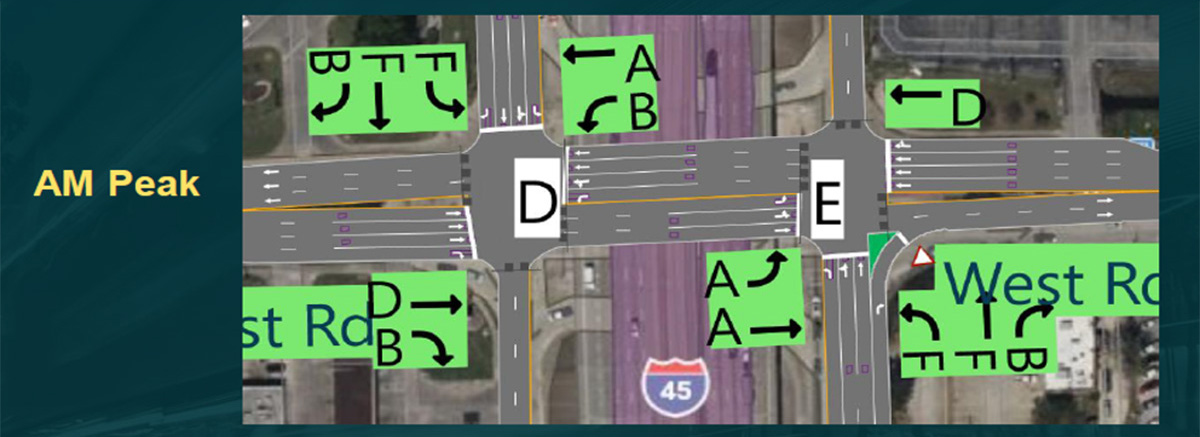
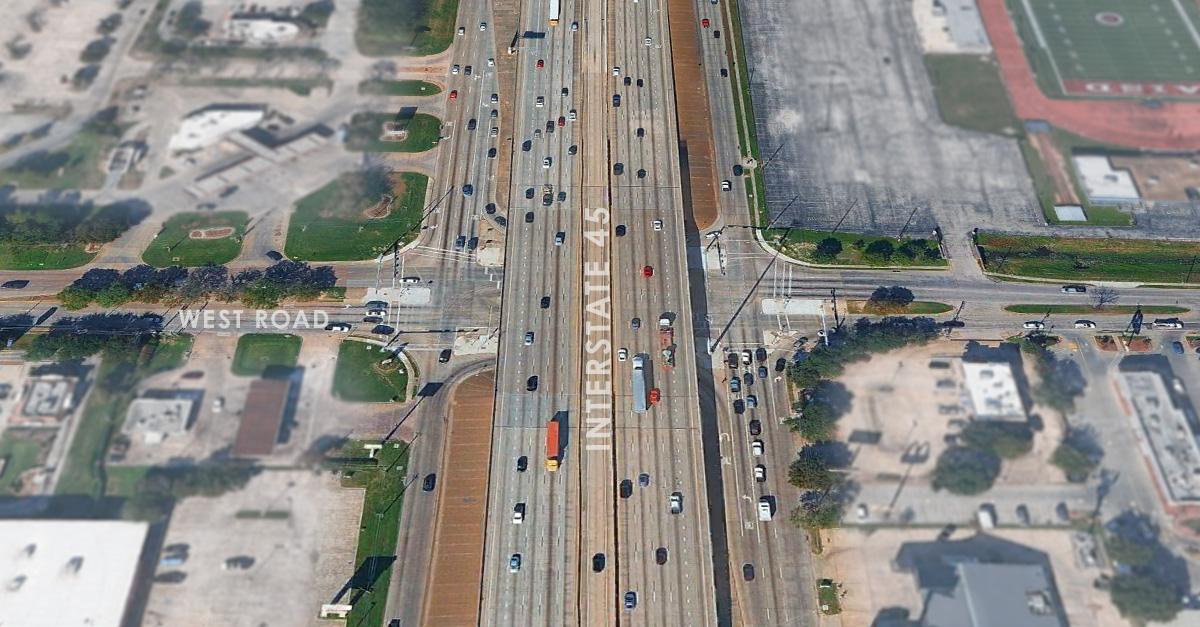
Example for improved traffic flow: West Road & Interstate 45
Planned Improvements
Fiederlein estimates that it will take 2-4 years to complete the improvements recommended by the traffic study. He says that the North Houston District will dedicate budget for the next several fiscal years toward projects born out of the study.
The SYNCHRO software assigns letter grades (A-F) to each intersection in the study depending on traffic flow and safety issues. Failing flow grades and hotspots for safety problems will be addressed as a first priority.
Currently, AECOM is finalizing a report with recommendations for each intersection included in the study.
Working Collaboratively to Improve Mobility in the District
The North Houston District crosses over the City-County boundaries, so many intersections in the study are controlled by one of those two entities or TxDOT. When the study concludes, NHD will meet with relevant stakeholders to share findings of the study. These partners may choose to take on some of these projects themselves, or, if the potential timelines are too long, NHD may be able to complete the work faster.
In either case, the District will collaborate with the appropriate entities for approval and execution of all projects.
We’re addressing the needs of today and planning for tomorrow.”
The Impact of Infrastructure Updates
The changes suggested in the study will benefit area businesses and residents by fixing traffic flow, resulting in fewer delays during the 7-9 a.m. peak and 4-6 p.m. peak. This means no long queues of trucks clogging the roadways and making people late to work, and fewer crashes, improving safety. Overall, the improvements will make the grid flow better as a system and in high-traffic areas.
“If you’re traveling down Aldine Bender or West Rd corridors, you’ll have five or six signals in a row along that stretch of road. We’re working to coordinate signals to flow better down those corridors. So, if you’re going the speed limit, you’ll hit green lights all the way down,” Fiederlein shared.
Without necessary infrastructure improvements, future industrial and manufacturing growth could be hampered. Fiederlein emphasizes that the North Houston area will continue to develop, and addressing traffic flow and safety now will help to future-proof the area and accommodate increased growth.